In just over six months, India's Election Commission removed tens of millions of citizens from voter rolls in a procedural exercise critics call vote chori — vote theft. The disenfranchisement disproportionately hit Muslims, Dalits, migrants, and the poor. Even an Indian Air Force Wing Commander with a diplomatic passport was deleted. It is also the clearest live example of a global pattern: how modern democracies are being unwound, not by tanks or coups, but by paperwork.
By T. DenoyoPublished May 7, 2026Read ~14 minutesSources Election Commission of India · ADR · V-Dem 2026 · Al Jazeera · UCA News
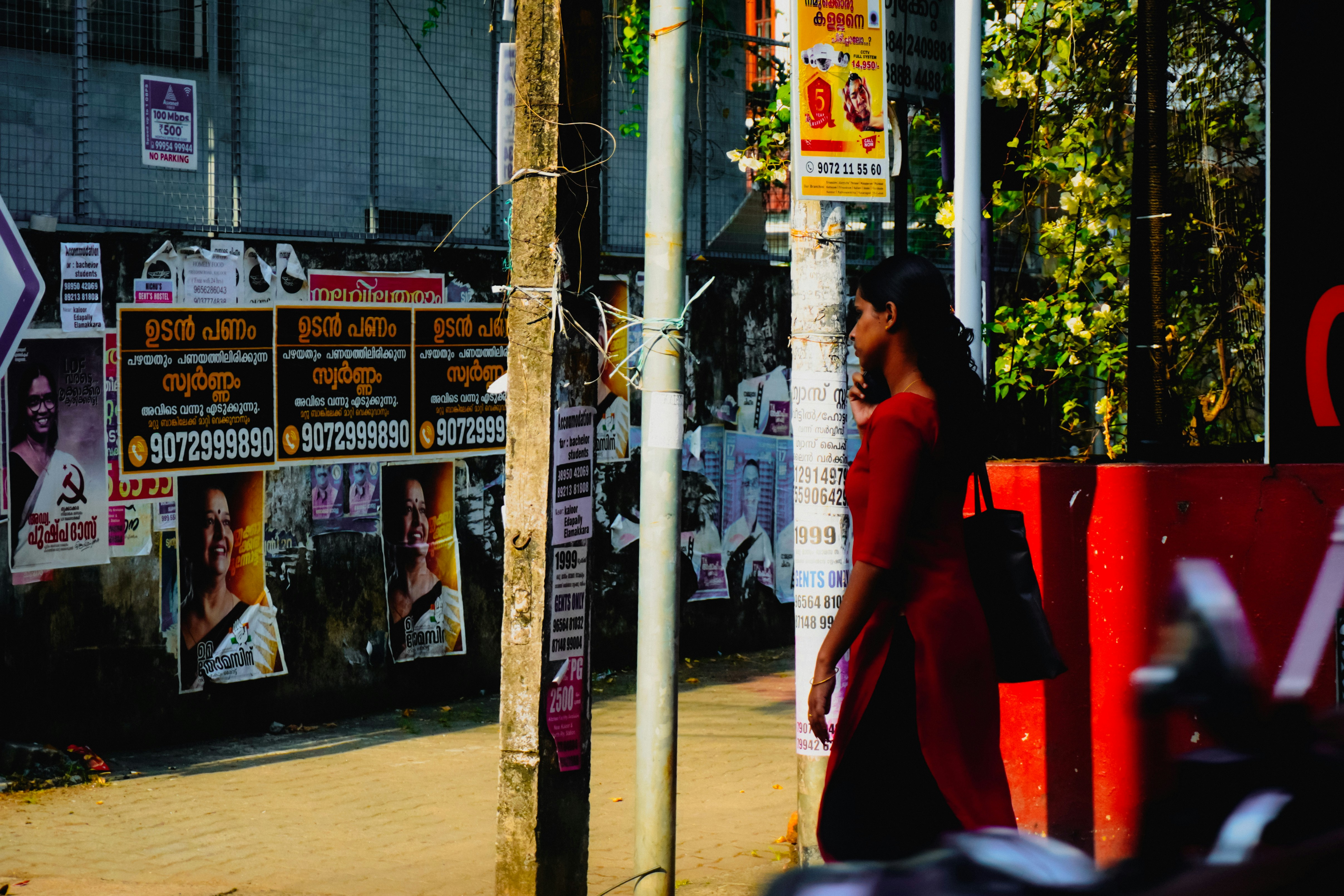
Kerala — one of nine states currently under SIR Phase II. 510 million voters across India are subject to the same revision exercise that erased 4.7 million names from Bihar's rolls and 9.1 million from West Bengal's. The walls she walks past are democracy's evidence; the rolls are democracy's record.
India's Election Commission rolled out the Special Intensive Revision (SIR) of electoral rolls in two phases between June 2025 and April 2026. Voters were required to re-register and produce specific documents — Aadhaar cards, voter IDs, and ration cards were excluded as valid proof. Migrants and the poor, who often lack other documentation, were disproportionately removed.
Uttar Pradesh
India's most populous state · 240M people
~14% of electorate
20.4M
deleted
West Bengal
Hindu refugees, Muslims, Matua community
~10% of electorate
9.1M
deleted
Bihar
India's poorest state · 75M migrant workers
~6% of electorate
4.7M
in final list
Other Phase II states
9 states + 3 union territories
est. ongoing
~1M+
est.
~35M
Total voters deleted across India in SIR Phase I + II — more than the population of California.
510M
Voters across 321 districts and 1,843 assembly constituencies currently subject to Phase II revision.
The mechanism · how to disenfranchise legally
The four-step paperwork coup
No troops were needed. No coup attempt was staged. The legal architecture for mass disenfranchisement was already in place — the Election Commission simply chose to use it.
01
Demand re-registration of every voter
In June 2025, the ECI ordered all 80 million Bihar voters to re-register within one month — providing one of 11 specific documents.
02
Exclude the most common forms of ID
Aadhaar, voter ID cards, and ration cards — the documents most Indians actually possess — were excluded as valid proof of identity.
03
Set an impossible deadline
Forms had to be submitted within 30 days. 7.5M+ Bihari migrant workers were not even physically in the state during the verification window.
04
Delete the unverified
Only ~30,000 of 4.7M deleted Biharis successfully filed for re-inclusion. Districts with high Muslim populations saw the highest deletion rates.
The pretext
"Foreign illegal immigrants" — and why this excuse is familiar
The Election Commission of India offered a justification that, on its surface, sounded technocratic: electoral rolls had not been comprehensively revised since 2003, and there were concerns about deceased voters, duplicates, voters who had moved, and "foreign illegal immigrants" who had obtained Indian voter IDs. The exercise, the ECI said, was about the integrity of the rolls.
The framing was lifted directly from the political vocabulary of the Bharatiya Janata Party. Since losing its parliamentary majority in 2024, the BJP under Narendra Modi has increasingly emphasized illegal immigration from Bangladesh — particularly Muslim migration — as a national emergency. India's Border Security Force, which guards the Bangladesh border, falls under the Home Ministry led by Amit Shah, Modi's closest political ally. The Election Commission's framing was the BJP's framing.
What the framing obscured: the people most likely to be removed weren't undocumented Bangladeshis. They were Indian citizens who couldn't immediately produce one of the eleven specific documents the Election Commission demanded. The crisis the SIR was supposedly addressing was largely a political fiction. The disenfranchisement it produced was real.
Reports from the field documented severe anxiety, distress, and even reported suicides among voters fearful of being erased — particularly among Hindu refugees from Bangladesh in the Matua community of West Bengal, who had legally settled after 2002 and could not trace their lineage to the 2003 voter rolls. The fear was not abstract: linked in the public imagination to the National Register of Citizens, the consequences of being removed extended beyond losing a vote — they extended to losing recognized citizenship.
Case study · Bihar
The state where the playbook was tested
Bihar has 80 million voters and is India's poorest state by per capita income. More than a third of its population lives in poverty. Roughly 7.5 million Biharis migrate to other parts of India for work. It is also one of India's most politically important battlegrounds.
The Election Commission announced the SIR for Bihar on June 24, 2025 — four months before the assembly elections. Voters had until July 25 to re-register. The list of 11 acceptable documents did not include the most common forms of Indian ID. Migrants working in Mumbai, Delhi, Kolkata, or Chennai had four weeks to return to Bihar with the right paperwork or be removed.
By August 2025, the draft revised rolls excluded 6.5 million voters. The Supreme Court intervened, requiring the ECI to publish a district-wise searchable list of all deletions with reasons, accept Aadhaar and voter ID for re-inclusion claims, and instruct political parties' booth-level agents to assist affected voters.
The Court's intervention helped — but not enough. The final published list still excluded approximately 4.7 million voters, roughly 5-6% of the entire Bihar electorate. Of those, fewer than 30,000 successfully filed for re-inclusion within the time window. Districts like Kishanganj, with a large Muslim population near the West Bengal border, saw unusually high deletion rates. The Election Commission has not released disaggregated data that would allow public verification of whether deletions were ethnically or politically targeted.
Then, between September 1 and September 30, 2025 — after the "final" rolls were published — the ECI quietly added approximately 500,000 new voters to Bihar's rolls without explanation. The Association for Democratic Reforms documented this as a fault line in itself: the same exercise that disenfranchised millions of poor and migrant voters apparently created space for the addition of half a million unvetted new ones.
"The big picture: vulnerabilities at all three crucial steps — the sanctity of the electoral rolls, the integrity of the voting process, and the fairness of the counting of votes."
— Association for Democratic Reforms · Article 14 analysis · October 2025
Case study · West Bengal — where the mask came off
When passports were not enough
If Bihar tested the playbook, West Bengal escalated it. The state's voter roll revision became the harshest in Indian electoral history — and produced the cases that demolish the official defense that the SIR is just clean record-keeping. It is not. People with valid documentation were deleted anyway.
West Bengal is governed by the opposition Trinamool Congress, a long-running political enemy of Modi's BJP. It received the harshest SIR exercise of any Indian state. Assam, by contrast — which actually borders Bangladesh and has been at the center of the immigration debate for decades — got a much softer process with no document verification and no 2002-roll linkage requirement. The reason given was Assam's ongoing NRC, which when completed in 2019 had embarrassingly excluded more Hindus than Muslims. So the SIR was relaxed in Assam to avoid producing the same result. The exercise was applied where it would help the BJP and softened where it wouldn't.
The result: 91 lakh (9.1 million) West Bengal voters from the 2024 elections are missing from the 2026 rolls. An algorithm flagged 1.67 crore citizens (16.7 million) for "logical discrepancies" — minor name spelling differences, age-gap inconsistencies in family records, name variations after marriage. These are common record-keeping artifacts in India. They became grounds for deletion.
Crucially, in West Bengal — unlike in Bihar — voters who submitted documents were still rejected. The "logical discrepancy" algorithm overrode documentary proof. This is where the SIR's official defense — that it just removes ineligible voters — collapses. Voters who showed up at hearings with passports, voter IDs, and birth certificates were deleted anyway. Many were never called to hearings at all.
The deletions that broke the official narrative
Six West Bengal voters who had the right papers
Case 01
Sadam-ul-Haq
Voter · had passport
Submitted his Indian passport as proof of identity and citizenship. Deleted because of a single space in his father's name on the 2002 roll versus his current ID. The algorithm flagged it as a "logical discrepancy."
Case 02
Wing Commander Md Shamim Akhtar
Indian Air Force · 17 yrs · diplomatic passport
Retired IAF officer with 17 years of service. Holds a diplomatic passport. Was never even called for a hearing. Name simply deleted from the rolls.
Case 03
Sahidullah Munshi
Former Calcutta High Court judge
Name deleted. Wife placed under "review." Son forced to apply as a new voter — as if the family had never existed in the rolls.
Case 04
Richa Ghosh
Cricketer · World Cup-winning Team India
Discovered her name was under adjudication while she was in Australia on tour with Team India. One of the most prominent women athletes in the country.
Case 05
Nandini Chakraborty
First woman Chief Secretary, West Bengal
The senior-most administrative officer in the state's history. Her voting status was suspended by the algorithm.
Case 06
Mohammad Shafiul Alam
Booth Level Officer · ECI field staff
One of the very government officials the ECI deployed to verify other people's voter status. Had his own name deleted while conducting the exercise.
If a Wing Commander with a diplomatic passport, a sitting Booth Level Officer, a former High Court judge, a former state Chief Secretary, and a national cricketer can all be deleted from the rolls — after submitting valid documents — then the official explanation that the SIR is simply removing ineligible voters falls apart entirely. The algorithm does not care about your documents. It cares about producing a smaller voter roll.
The targeting · who was deleted
A pattern too consistent to be accidental
Activist Yogendra Yadav's field investigation in West Bengal documented the deletions by community. The numbers cannot be explained by any neutral process of "cleaning up the rolls."
Muslim share of population vs. Muslim share of deletions · West Bengal
Where Muslim voters are concentrated, deletions concentrate too
Nandigram constituency
Muslims are 25% of population
95% of deletions were Muslim
3.8x
over-targeting
Bhabanipur constituency
Muslims are ~40% of population
90% of deletions were Muslim
2.3x
over-targeting
West Bengal overall
Muslims are 27% of state population
65% of deletions were Muslim
2.4x
over-targeting
Adjudication cases
From Murshidabad + Malda · 2 of 23 districts
~33% of cases
3.8x
over-targeting
Across India's most politically diverse state, Muslims constitute 27% of the population — but 65% of those whose names were removed from the voter rolls. In Muslim-majority constituencies, the over-representation reaches 3.8x baseline. No neutral algorithm produces those ratios. This is not record-keeping. This is targeting.
Activist Yogendra Yadav, who led the field investigation in West Bengal, summarized the picture in a single sentence in his February 2026 interview with The Federal: "To put it bluntly, the Election Commission, in league with the BJP, has deleted 27 lakh votes in a targeted political exercise." The Supreme Court invoked Article 142 to create a hearing mechanism and offered an appeals process. By the time appeals could meaningfully proceed, the lists were frozen. The elections were over. Yadav's metaphor: "It is like saying we will improve the operation, but the patient is already dead."
This is what makes the SIR not a paperwork exercise but a political weapon. Bihar tested it. West Bengal showed what it does when there is no political incentive to soften it.
The institutional capture
How the Election Commission became an arm of the ruling party
Until December 2023, India's Election Commissioners were appointed by a panel that included the Chief Justice of India — a structural check on partisan appointments. The Modi government changed that. The Chief Election Commissioner and Other Election Commissioners (Appointment) Act of 2023 replaced the CJI with a cabinet minister chosen by the Prime Minister. The result: a panel where two of three members are direct presidential appointees. The government effectively assumed majority power to appoint election commissioners.
The ADR and other civil society groups challenged the law before the Supreme Court in January 2024. As of mid-2025, the case had been adjourned multiple times — the Court "did not have the time" to hear it. Election commissioners now also enjoy unprecedented legal immunity for actions taken in their official capacity, making post-facto accountability nearly impossible.
The pattern is a familiar one in democratic backsliding literature: capture the body that runs elections, then use that body to shape who can vote. The mechanism doesn't even need to be obviously illegal. It just needs to be procedurally unassailable. The genius of the SIR exercise is that every step of it has a paper trail showing it was done according to law.
The bigger pattern
India is not alone — democracy is unraveling globally
The V-Dem Institute's 2026 Democracy Report, "Unraveling the Democratic Era?", finds that nearly a quarter of the world's nations are currently undergoing democratic backsliding. For the first time in over 20 years, there are more autocracies than democracies in the world.
91 vs 88
Autocracies now outnumber democracies
For the first time in 20+ years. ~40% of the world's population now lives under authoritarian governance.
~25%
Of the world's nations are currently autocratizing
According to V-Dem 2026, including 6 of the 10 newest backsliding countries — most of them in Europe and North America.
1978
Global democracy levels are now back where they were in 1978
Per V-Dem's Liberal Democracy Index. Nearly five decades of democratization erased in the past two decades.
Newly identified backsliders · V-Dem 2026
Country
Pattern
Status
United States
"Unprecedented" decline in 2025 — Trump 2.0 administration ignoring court rulings, targeting critics, attacking immigrants in violation of civil rights
Severe
India
Mass voter roll deletions, capture of Election Commission, attacks on press freedom, demonization of Muslim minorities
Severe
Hungary
Long-running media capture, judicial restructuring, electoral rule manipulation under Orbán
Established
Italy
Press freedom decline, anti-NGO legislation, attacks on judicial independence under Meloni
Newly identified
United Kingdom
Restrictions on protest rights, voter ID requirements introduced in 2023, attacks on independent media
Newly identified
El Salvador
Bukele consolidation, suspended civil liberties, indefinite detention without due process
Severe
Nicaragua
Closed civic space, mass exile of opposition, jailing of clergy and journalists
Authoritarian
Haiti
State collapse — gangs control 85% of Port-au-Prince; unable to hold elections
State failure
The pattern
The shared backsliding playbook
The mechanisms are remarkably consistent across the dozen-plus democracies currently autocratizing. The vocabulary differs. The instruments are the same.
Capture the referee
Replace independent election bodies, courts, and prosecutors with appointees loyal to the executive. India: 2023 Election Commission Act. US: politicized DOJ leadership and judicial appointments. Hungary: court-packing.
Demand papers
Tighten voter ID and registration requirements in ways that disproportionately exclude minorities, the poor, the migrant, and the elderly. India: SIR. US: state-level voter ID laws. UK: 2023 Elections Act voter photo ID requirement.
Frame the scapegoat
Attribute the need for restrictions to a manufactured crisis of "illegal" or "ineligible" voters. India: "foreign Muslim infiltrators." US: claims of widespread non-citizen voting. UK: rhetoric on small-boat arrivals.
Use national security framing to justify surveillance, restriction of dissent, deportation of critics. US: ICE operations against student protesters. India: sedition charges against dissenters. UK: National Security Act expanded scope.
Maintain elections
Crucially: keep holding elections. The contests just gradually become less meaningful as the playing field tilts. This is what makes it backsliding rather than coup. The forms persist while the substance hollows out.
Closer to home
Why this matters for Americans
The Century Foundation's January 2026 democracy assessment found that "in the first year of Trump 2.0, the United States went from being a passing if imperfect democracy to behaving like an authoritarian state: breaking the law, ignoring court rulings, engaging in grand corruption, targeting critics for persecution." The V-Dem 2026 report calls the US decline "unprecedented" in speed.
The American mechanisms differ from India's, but the structural pattern is the same. The federal election security agency CISA has lost over 1,000 employees in the past year. Voter ID requirements have multiplied at the state level. State Department forced retirements have reduced institutional capacity. The Department of Justice has formally referred career attorneys for "discipline" over court testimony. Federal lawyers have been formally accused by judges of dishonesty. Critics have been criminally prosecuted for political speech (the second Comey indictment last week, over a year-old social media post).
None of these individually constitutes a coup. None individually breaks democracy. That is precisely the point. Backsliding works because no single step is dramatic enough to trigger the political immune response. By the time the cumulative effect is visible, the institutional architecture for resistance has already been weakened.
What India's vote deletions show — vividly, at scale, with publicly documented numbers — is what this looks like when it succeeds. 35 million voters disappeared from the rolls of the world's largest democracy in less than a year. No troops were involved. No emergency was declared. No constitution was suspended. The mechanism was paperwork, deadlines, and the strategic exclusion of the documents people actually possess.
What we are watching
The Bihar election went ahead in November 2025 with 4.7 million fewer voters on the rolls. The phase II revision is currently underway across nine states and three union territories — covering roughly 510 million voters. Uttar Pradesh, where 20 million names have already been deleted, is critical to the BJP's national majority.
India's Supreme Court has issued partial remedies but has not stopped the process. The Election Commission, now functionally captured, will determine which states see SIRs, on what timetable, and with what evidentiary standards. The next general election is scheduled for 2029. The shape of the rolls by then is being decided right now, district by district, deletion by deletion.
Democratic backsliding doesn't look like tanks in the streets. It looks like a 11-document checklist, a 30-day deadline, and a migrant worker who can't get back to her home village in time to register. It looks like the Election Commission of the world's largest democracy quietly removing 35 million names from the rolls — and a global news cycle barely noticing.
The Indian opposition has a phrase for what is happening: vote chori. Vote theft. It is the most accurate political term coined anywhere in the world in the past five years. It names something the established political vocabulary of "voter suppression" or "electoral integrity" has been struggling to capture.
Watch India because what is happening there is happening, in different vocabularies and at different paces, in a quarter of the world's countries. Including, increasingly, the United States.
Democracy doesn't require tanks to die. It can be undone with a checklist.